Bloombay
BB-M180 Hard Microcrystalline Wax Additive
BB-M180 Hard Microcrystalline Wax Additive
Couldn't load pickup availability
BB-M180 Hard Microcrystalline Wax Additive is a medium-high melt micro wax used in candle making and wax blending to improve opacity, whiteness, surface finish, structure, and formula stability. It is especially useful for paraffin pillar, votive, molded, hurricane, and taper candle formulas.
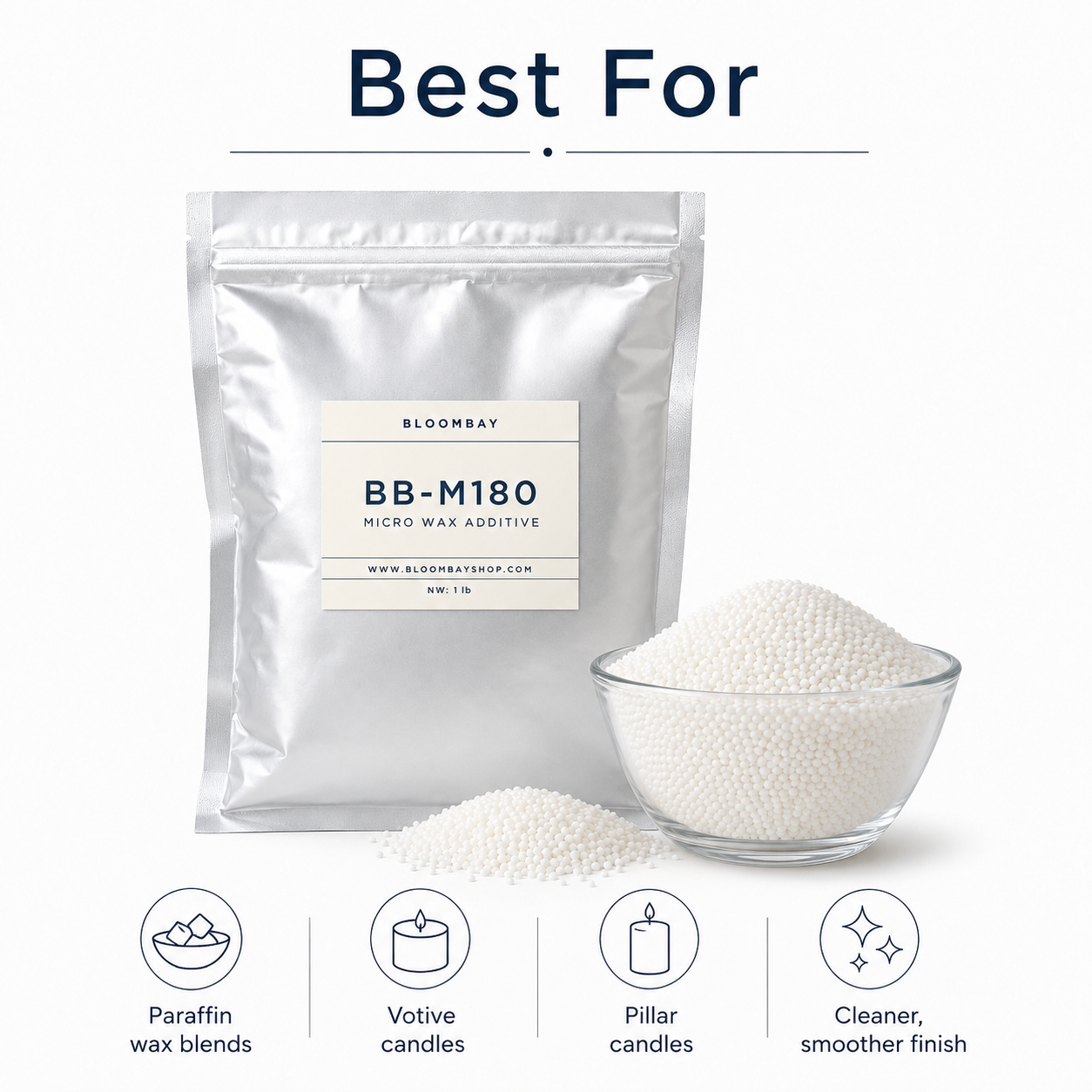
Best For
- Paraffin pillar and votive wax blends
- Molded candle formula testing
- Hurricane shells and dipped tapers
- Makers improving opacity, surface finish, and structure
Additive Properties
Description
BB-M180 Microcrystalline Wax Additive is used to improve paraffin candle formulas by increasing opacity, whiteness, surface smoothness, and structure. It is firmer than softer micro waxes such as BB-M170 and BB-M175, making it a stronger option for pillar, votive, molded, taper, and hurricane-style wax testing.
This is not a ready-to-use standalone candle wax. It should be used as part of a tested formula with paraffin, pillar wax, taper wax, molded wax, or other compatible waxes.
Key Features
- Microcrystalline wax additive for candle formulas
- Helps increase opacity and whiteness
- Can reduce surface imperfections in paraffin blends
- Can help prevent oil migration in tested formulas
- Can reduce brittleness compared with straight paraffin
- Useful for pillar, votive, molded, taper, and hurricane candle testing
How to Use
- Cut or break the micro wax into smaller pieces.
- Weigh the additive based on your total wax formula weight.
- Melt with your chosen wax blend until fully liquid.
- Stir slowly until the micro wax is completely blended.
- Add dye and fragrance oil at your tested temperatures.
- Pour into your prepared mold, votive mold, pillar mold, taper setup, or test batch.
- Allow the wax to cool fully before judging opacity, surface finish, and burn behavior.
Formula Testing
BB-M180 changes the structure and appearance of a wax blend. It can improve opacity, whiteness, smoothness, and oil control, but too much may make the wax overly hard, cloudy, difficult to wick, or harder to release from some molds.
Start with controlled test batches. Every wax reacts differently, especially paraffin blends, soy-paraffin blends, pillar waxes, votive waxes, and finished commercial wax blends.
Best Uses
- Pillar candles: Helps improve opacity, structure, and surface quality.
- Votive candles: Can improve whiteness and reduce surface imperfections.
- Molded candles: Useful when testing smoother finish and reduced brittleness.
- Dipped tapers: Can support structure and a more polished wax finish.
- Hurricane shells: Can be tested when firmness and opalescent appearance are desired.
- Paraffin blends: Helps control oil migration and improve wax cohesion.
Troubleshooting
BB-M180 is stronger than softer micro waxes. Small percentage changes can affect hardness, finish, fragrance behavior, and wick performance.
- Wax becomes too hard: Lower the BB-M180 percentage or blend with a softer compatible wax.
- Cloudy or overly opaque finish: Reduce usage rate or adjust dye and additive levels.
- Poor mold release: Test a lower percentage, longer cooling time, or a different mold temperature.
- Weak hot throw: Reduce additive load and re-test fragrance load and cure time.
- Surface imperfections: Check melting, mixing, pour temperature, and cooling speed.
- Unstable burn: Re-test wick size after every additive change.
Shipping & Storage
Store in a cool, dry place away from direct sunlight, heat, moisture, and strong odors.
BB-M180 comes in slab or piece form. During hot-weather shipping, the wax may show surface marks, soften slightly, or stick together. This usually does not affect usability. Let the wax return to room temperature before cutting, weighing, or melting.
Q & A
Is BB-M180 a candle wax?
It is better treated as a wax additive or blending wax, not a ready-to-use candle wax by itself.
What is BB-M180 best used for?
It is best used for paraffin pillar, votive, molded, taper, hurricane, and custom wax formulas that need better opacity, structure, surface finish, or oil control.
Is BB-M180 a hardener?
It can add structure and firmness, but it should not be described only as a hardener. It also affects opacity, wax cohesion, oil migration, surface quality, and brittleness.
How much BB-M180 should I use?
Start around 3–5% of total wax weight for pillar and votive formulas. Higher percentages may be tested for hurricane shells, dipped tapers, or molded candles, but only in small test batches.
Can I use BB-M180 with paraffin wax?
Yes. This is one of its best uses. It can improve opacity, whiteness, surface finish, and oil control in paraffin formulas.
Can I use BB-M180 with soy wax?
You can test it, but use caution. Soy wax is sensitive to frosting, rough tops, crystallization, and surface changes. Start very low and test before production.
Can I use BB-M180 for container candles?
It can be tested in custom container blends, but it is not a finished container wax. Too much can affect adhesion, burn quality, and hot throw.
Can I use BB-M180 for pillar candles?
Yes, it can be tested in pillar formulas, especially paraffin pillar formulas that need more opacity, smoother finish, or reduced brittleness.
How is BB-M180 different from BB-M175?
BB-M180 is firmer and more structure-focused. BB-M175 is slightly softer and more useful when you still want tack, adhesion, and flexibility.
How is BB-M180 different from BB-M195?
BB-M195 is higher melt and harder. It is better for stronger hardening and heat resistance. BB-M180 sits in the middle: more structure than BB-M175, but less extreme than BB-M195.
Can BB-M180 reduce mottling?
Yes, it can help reduce mottling in some paraffin formulas. If you want a deliberate mottled effect, use caution because BB-M180 may work against that look.
Why did my scent throw get weaker?
Too much micro wax can change how fragrance releases from the wax. Lower the additive percentage and re-test fragrance load, wick size, and cure time.
Is BB-M180 beginner-friendly?
It is better for intermediate makers. Beginners can test it, but it must be measured carefully and used in small batches first.
Share